Wednesday, January 25, 2017

Poem366: EDIE (WHISPERING) by Sarah Nichols


The copyright page of any dancing girl press chapbook series title includes a brief statement about the press and its mission, which is distinctive. It states, “The series seeks to publish work that bridges the gaps between schools and poetic techniques—work that’s fresh, innovative, and exciting.”

Those descriptors most definitely apply to the 2015 release Edie (Whispering): Poems From Grey Gardens by Sarah Nichols. All of the poems in this collection were sourced from the dialogue transcripts of the documentary Grey Gardens, and specifically the voices of Big Edie (Edith Bouvier) and Little Edie (Edie Beale), the residents of Grey Gardens.

For those who don’t know the 1975 documentary, it is about the two characters, an impoverished mother and a daughter, who lived in a run-down mansion in a rich neighborhood in East Hampton, New York. The two women were the aunt and the first cousin of Jacqueline Kennedy.

The language in Nichols’ work comes directly from the transcripts. The very first poem, “Mother Do You Realize,” sets up the project very dramatically:

Mother do you realize I love Marlene Dietrich?
Mother do you realize I’m singing?
Mother do you realize that the scene is set and
that I’m dying away?

These questions are strange and compelling, and they’re just the kind of thing one can imagine being discussed in a house full of trash, cats, and raccoons.

That poem is in the voice of the daughter, but the mother, too, is represented, as in “Mrs. Beale.” Here Big Edie recalls her youth and beauty. “Everybody thought I was perfectly terrible. / I think I have to go back to bed, she states.

Both women are interesting characters, which I guess I’m using as a term of benign mockery, as my own mother used to—“What a character,” she’d say about someone truly odd. Their unusual character traits show up in such poems as “The Best Costume,” which contains the assertion, “I / don’t like women in skirts.” The poem continues,

I can’t help it: I
like to wear certain things.

A kimono, a cape, pants
under the skirt, stockings
up over the pants—

I have to think thee things up, you know,
and
this is the best thing to wear for the day.

I’ve always been fascinated by the relationship of the women who lived in Grey Gardens, and Nichols uses their own words to present poems that showcase their unusual ways of making their way through the world.


It is an interesting project, too, and a fast but evocative read.

It's a blog's life


Look, I’m not asking for sympathy, but it’s hard to be a daily blogger.

Today, I taught four classes and then hit the road to drive six hundred miles to a reading. I’m bushed, I’m in a hotel room, it’s nearly midnight—but I’ve committed to write three blog posts each day.

I read and review a book of poetry every day, and that’s something I prepared for before leaving. I also write a post about an issue related to writing or creativity (I think of this as the real substance of my blog). And I’ve also taken to posting erasures of presidential statements from each day.

I had to skip dinner, and half of a Slim Jim sits in my stomach like a fat man stuck in a bathtub. My eyes are closing, and I have to be up in four hours.

It’s cool. It’s coming together, and I’ll keep this one short. But sometimes in our writing we make commitments—to ourselves, to some idea of an audience, to our muse/genial spirit/God. And when we don’t meet those commitments, it can set us back a little. Writing lulls begin, after all, with a missed commitment to the self.

We put ourselves into this kind of pickle because we wanted to do something strenuous or ambitious—to push ourselves as far as we can.

And tonight I can be pushed as far as a brief handful of blog posts and then bed.


But I kept my commitment. It’s not even midnight yet.

Tuesday, January 24, 2017

Poem366: FUGITIVE BLUES by Debra Kang Dean


In 2014, Debra Kang Dean released Fugitive Blues, a chapbook that won the Moon City Press Blue Moon Chapbook Contest. The contest itself was short-lived, but I think this lovely little book deserves a long life.

In her endorsement of the book, poet Sarah Freligh writes that Dean’s poems “are at once small and large, honoring the ordinary even as they consider the ontological.” This is the most apt description I can think of for Dean’s work. Each of her poems can consume my attention for a long time—physically small, but very dense and philosophical. A small book of her work is more fulfilling than the full-length collections of many other poets.

The chapbook leads off with “Punchbowl,” set in the National Memorial Cemetery of the Pacific in Punchbowl Crater, Honolulu. It’s a setting that has meaning for Dean:

On the slopes
of this crater, I saw the after-effect of slaughter
on a small scale—some mongoose or stray

had found its way into my brother’s pigeon coop
and scattered the flock that never came back.

Dean writes of this land as her homestead.

The inexorable law of bodies
tells us no two can occupy the same space.
Some must leave that others might live. Go back
where you came from. But there’s no there there
to return to. Tonight I have climbed from my father’s house

up over the rim and descended into the crater to lie,
sober, among the dead.

There is a lot of history in the book, including capital-H history, like this poem, which happens at the site of Ernie Pyle’s grave.

But there is also natural history, and there’s astronomy, which is entirely beyond the purview of history, and there’s nature study, as in “Ode to the Brown-Headed Cowbird.”

Brood parasite of those passerines,
with your leatherlike hood,
your iridescent black body,

neither the plagiarist of the aviary nor
the sequined harlequins are as reviled
by lovers of songbirds as you are.

This is how she introduces the cowbird—with vivid description that Dean then follows up with a very tender look into the birds’ lives:

Forty eggs will your mate lay
each in a different nest—warbler’s,
red-winged blackbird’s, junco’s …

If not turned out or pecked open,
they will hatch offspring
already skilled in begging.

With Dean’s loving attention, the bird takes on a larger presence, and it’s hard not to anthropomorphize its story.

Another bird poem I like quite a bit, “Song,” closes out this fine collection, and beautifully:

Goldfinches—they were—
not yellow leaves—four
drawn up
into the trees—a blur, 
black-laced raw color
borne up.
I was thunked, word-stirred:
Sunlight, sunlight, bird.


If you can get your hands on this rare and beautiful book, I encourage it.

What is your good name worth?


I have a friend who is an astonishingly talented poet. She writes work that has something to say, she is adventurous with syntax and form, and her work looks altogether fresh and interesting on the page.

Although she has a gorgeous first book, she is not having the success she aspires to with poetry, or at least not at the pace she would choose.

With work at a top-tier journal, she asked an interesting question: Exactly how helpful is a recognizable name for poets in the general submission pile?

The answer is complex, and it varies from journal to journal. An old, established journal isn’t likely to be excited by encountering a well-known name, but editors who have been working on journals for only a short time may feel downright thrilled.

And doesn’t it depend on the name? I can think of many writers who are coming onto the scene and getting a lot of social media buzz, but the fact is, an editor who is not very connected to social media may not even recognize such a poet. Sounds crazy, but you do run into the occasional (paper) bookworm on literary journal staffs, and some have no interest in networking, social or otherwise. That’s the kind of job they pawn off on to the intern while they interact with work, as editors have done for as long as there have been editors.

Certain names are so prominent in the field that nearly anyone would take notice. That’s not to say those prominent writers get an automatic in. Once, I was editing a themed issue of a journal for people from a specific region, and a writer I’d been hoping to include sent work. I was thrilled! This was one of the most notable names in the region, and a publication dedicated to that area would not feel complete without a representative sample of his work.

But then I read it. Instead of the guy’s usual work, which was fresh and contemporary, he had sent the worst kind of doggerel—straight and obvious rhyme, insipid subjects, unsurprising delivery. I really examined it, wondering if something important was happening and I was missing it. Was this a brilliant commentary of some sort that I wasn’t picking up on?

And that’s an example of one thing a name does for a writer. If that name is on something horrible, an editor might pause to ask, “What the hell?” That’s what I did, and for several minutes—before I wrote my “Thanks, but” letter.

Of course, a small journal that gets few submissions may be willing to let go of a few standards for the opportunity to print work by a well-known writer. That sounds like an unequivocally bad thing, to change standards for an elite writer, unless we consider why an editor might do that.

When prominent writers send to small journals, they often don’t send their best work. That’s a big danger of soliciting their submissions; on occasion, the journal ends up with a large selection of B-sides from such a writer. I like to think that big-name writers sometimes try out their risky new work with smaller journals, but that’s an optimistic take. The chances are that good work goes to prominent or paying journals, and lesser work, the stuff that has made the rounds many times, goes to lesser-known journals. I suppose they think they’re doing the small journal a favor—and the small journal often agrees.

But these same journals print work, often the best available work, by unknown writers, and the fact is that a beginning writer gains exposure and stature by appearing in an issue with a major prize winner or a beloved name. Some magazines even have the expressed mission of publishing emerging writers alongside established ones. I happen to think standards should remain high, regardless of who sends work, but although I never printed work of low quality, I can’t swear that I never bent a little.

This takes me away from my friend’s query. What does a name do for a writer?

Mind you, my friend is getting some recognition. She has a great blog that gets a lot of attention, she’s an editor for a small literary press, and she has an absolutely beautiful book. But she doesn’t consider herself to be prominent, not that the idea has much meaning in the poetry world. (Is the well-known poet the one who sells 2,000 books instead of 200?)

For me as a reader, a recognizable name serves one useful purpose. If I’m not sure about what it is I’m seeing—if I’m asking myself, “Is this good?”—I might trust a poet whose work I know in a way that I wouldn’t trust a stranger. When an editor is doing first readings of work, the desire is to cull the pile. Nothing in the life of an editor is more troublesome than the “maybe” pile, and anything that can knock a submission out of contention is a good thing. Otherwise, it goes into the small stack of possibilities—a stack that still contains fifty times more work than the editor has room for.

In my desire to reject as much as I can, I want to keep the maybe pile small. A recognizable name might keep a submission alive a little bit longer. That’s the advantage when I’m at the helm, and it’s a pretty good one. I’ll give that submission another look; it stays alive another few days.

It’s useful to remember how prominent writers became prominent. They’re good. Oh, occasionally they become prominent for other reasons—risk-taking, timely subjects, a gimmick, fame from another field—but in general, a poet whose name we know is a poet who has broken into many a journal, and whose work is very strong.

I think that’s what we want—to be good, first, and then for people to recognize that we’re good. And my friend is much more than good—the kind of good that makes it into the maybe pile, and beyond, solely on its merit.


I’m sort of excited for the future, when I can say I knew her when.

Monday, January 23, 2017

Poem366: IN BOTH HANDS by Joannie Stangeland


Myth and mystery inform the poems in Joannie Stangeland’s collection In Both Hands (Ravenna Press, 2014). Always, though, the poems are informed by close attention to the natural world.

A good example is found in “Eavesdropping,” where Stangeland writes,

The crow repeats its caw, a circle of sound like the rings of water after the stone drops. Reflections shattered by rhythm. The wind says its name, over and over. The water echoes the sky, copies each cloud, an ellipsis, what’s here, what left. The sun loves its own face, mirrored in every puddle, all the shiny scraps of trash. […]

I appreciate how the intersecting circles of caw, of sun and reflection of sun, operate in synch to create a larger whole, like a fractal pattern incorporated on the page.

This theme, edges giving way to other edges so the whole world becomes seamless, repeats in other poems, such as “Patience Is for Other Creatures.” Here, Stangeland writes, 

Fields blur, smudge
at edges, drift into trees.

Hours pool, spill
over, a flood.

The sun’s last look.

Crows wheel, roost 
in the night’s well,

in shadows buckled 
under my eyes.

I think the effect is a very subtle one, like a drawing in charcoal where edges blend and smudge, and it’s a beautiful effect in a single poem, but especially powerful when it occurs many times over.

In a review, it’s probably belaboring the point, but in the book it’s so powerful, the un-limned world. We see it again in “Palimpsest” (were even the title points to a there/not-thereness.):

Parchment paper sheets
unrolled, sand-colored,
thick and empty.

The ink a night.
My pen drew down,
wanting the lines right.

Each letter kept
its own character,
a different slant.


I recommend this beautiful collection, whose beauties accrue slowly, like cottonwood fluff drifting into a corner, approximating snow.

What do journals owe to former contributors?


Image courtesy of ClipartFest.com


A friend wrote to me last week, and she was feeling very disgruntled over a rejection she had received.

This friend is an old war horse, like me, and she doesn’t get riled about rejections. When you’ve been submitting for a long time, you accept rejections as a matter of course, and they don’t make you especially sad. (The down side, of course, is that acceptances no longer thrill; they’re better than the alternative, but they don’t make a long-time submitter and publisher feel giddy.)

My friend was feeling irritated because she sent a submission to a journal that had published her work before, and she received what was probably some version of the journal’s “good” rejection. (Most journals have at least two different form rejections, one saying “Thanks,” and the other saying, “Please try again.”) 

What happened next was interesting. My friend wrote back to ask whether the journal would be interested in seeing a revision, since the rejection was positive. That editor wrote her back to say this: “You are welcome to send a revision to [Journal Name] through Submittable if you would like. As you know, we are a tough mark with a less than 1 percent acceptance rate, but we would be happy to review anything you would send our way.”

This response really wasn’t an appropriate one to send to a former contributor. My friend had obviously broken through once, despite the 1 percent acceptance rate. Yet the editor wrote to her as if she were a stranger—and a novice. This, despite the record of her having published with the journal. As a former editor-in-chief of a literary magazine, I can say definitively that I would recognize any name from the past twenty years of publication, and if pressed, I could probably match that name up to a title. These names matter quite a bit to a journal; they helped to build the magazine’s reputation, and we often refer to our contributors as family. Any correspondence, and particularly any submission, from a member of the family was enthusiastically received and cordially responded to.

My friend got no such acknowledgement. This is complicated by the fact that she is an important editor herself, and in that capacity she has worked closely with the editor-in-chief of the journal that rejected her.

She told me that she knew the main editor would have been more collegial, whether accepting or rejecting. If that editor had had no interest in seeing a revision, he would simply have said, “No, thanks”—an answer that would have been perfectly acceptable.

What was desired by my friend was not special treatment for her work, but something else: an acknowledgement, maybe, that she had shared her talent and her name (it is a somewhat prominent one) to help advance the journal’s mission. While she didn’t put it this way, I believe it could be said that she wished to be received as family, just as I used to receive the writers at my national journal.

My friend gives this assistant editor great benefit of the doubt. “I know if we talked to these editors in person, they would be shocked to hear how their words are being perceived,” she told me. “They’re just trying to be professional. There’s a huge disconnect.”

This friend didn’t write to complain about her treatment, though. Instead, she wanted to raise an issue that was most pertinent to her, as an editor herself. She wrote, “Maybe the larger question is, ‘What do journals owe the writers they’ve published?’ It’s a curiosity I’ve been exploring in my head both as a writer and an editor. What do we owe each other?

“And maybe the answer is nothing.”

I don’t think my friend believes journals owe nothing to writers, because I’ve witnessed her welcoming, collaborative attitude toward writers many times—including times we served on a masthead together. 

And I don’t believe the answer is nothing. I think journals owe everything to writers. As most journals have started charging for submissions, and as many never send rejection responses (and even announce this as policy), and as many close reading periods without notice, editors seem to forget that writers are vital—that writers, in fact, are the heart of a journal, and without them a journal would fold.

It is true that many magazines contend with large numbers of submissions despite a small staff. But whether ten writers send work or ten thousand, journals should be honored to be entrusted with it, and they should show graciousness and care to all submitters. 


And they should especially show care to family.


Sunday, January 22, 2017

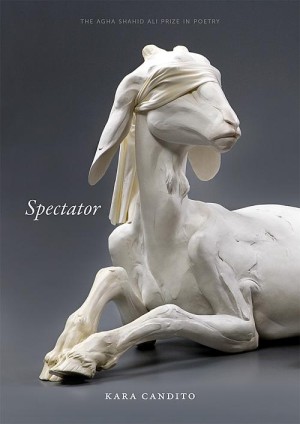
Poem366: SPECTATOR by Kara Candito


In Spectator by Kara Candito (The University of Utah Press, 2014), the poet’s second collection, Candito proves herself once again to be a surprising and sage voice, offering poems of candor and urgency.

The poems are emotionally intense, too—often funny, sometimes biting, and sometimes very sad. Mostly, though, I found them philosophically complicated, thick with insights.

This is not to say that they aren’t also sexually charged—and that’s exactly how I like my philosophy. This is true right from the start, with “Initiation #5: Lorca.” Candito writes about a vision of Lorca at her bed, and she notes, strangely, that “Burning casinos and countries I’ll never visit / pass over the room.” That’s a realistic dreamscape for me—weird as hell, disparate things (Lorca, casinos) enjambed and entwined.

Later in the poem, this:

Inside, in another dimension, we are riding
two lame mares to the pasture where I am
ravaged by centaur after centaur, never a satyr.
Bodies matter, how they break open,
which animals we let inside us. I am here
to learn how to suffer more beautifully, ….

Despite the problematic idea of a woman being ravaged as a beautiful form of suffering, Candito goes there, and it’s again in keeping with dreams, which don’t know the rules, or which ignore them. She dares. She shocks. And frankly, this old editorial war-horse has read a lot of poems, and doesn’t generally shock.

The second poem in the book, “A Short Genealogy of Power Tools,” also allows a bald look at a particular consciousness, as it outlines so many manners of suffering a teen knows. I like that it picks up on aspects of that first poem, where bodies break open, as if the progression of poems is a game of crack-the-whip:

There was this shed behind the prefab house
     where I straddled a boy named Boomer
on his father’s John Deere. Into the shaved back
of his head, I dug my nails to pretend they were
          power tools; my hands blasting
his body open, so I could crawl inside and make it mine.

In many ways, the body is pinned to a dissection tray in this collection, and it’s a painful examination that the poet doesn’t shy from.

In my favorite poem in the book, “Deathbed,” the poet is straightforward about what it means to write—a topic of enduring interest to me, as my blog reveals—and as a bonus, she is also very funny (I guess most people would say darkly so, but that’s the only stuff that’s really very funny to me).

The poem is about the speaker/poet’s own deathbed. “If you think it’s just another lurid metaphor, / then I applaud your worldliness,” she begins, and notes, 

                    […] I grew ugly. I encountered 
metaphors at night, slumping in my chair

     like a Chilean dictator renouncing all former ties
               to frivolous displays of power. Have you 
          ever been embarrassed by a metaphor?
It is embarrassing to write. This is why I wear an expression
     of crude conviction, the one that made my mother say:
Stop making squinty faces. You’ll get wrinkles.


Notice how Candito lets herself be ugly—squinty, embarrassed, crude? It’s good to spend time with someone like that—not putting on airs, and willing to say the embarrassing thing in the purpose of making meaning.